Redesigning the Service Behind Death Certification Across England and Wales
Client
DHSC Medical Examiners Service
Year
2019

The Medical Examiners programme was created to introduce independent scrutiny into the death certification process and improve the experience for the professionals and bereaved families moving through it. The existing service relied heavily on paper records, disconnected systems and local processes that varied between organisations. Cases were difficult to track, information was repeatedly entered, and responsibility was not always clear.
Working with the Department of Health and Social Care through Methods, I led product and service design across Discovery, Alpha and Private Beta. My role covered the full service rather than only the digital interface. I mapped the existing process, developed service blueprints and user journeys, defined the information architecture and translated policy and operational requirements into testable workflows and prototypes.
Research involved medical examiners, medical examiner officers, qualified attending practitioners, registrars, coroners, bereavement teams and other people involved in the certification journey. We travelled to Coventry to observe working practices and speak directly with medical professionals. Those findings shaped the user needs, personas, service blueprints, case management flows and priorities for the minimum viable service.
I worked closely with user research, content design, policy, delivery, architecture and development. Designs were tested throughout the programme and refined as the service developed. This included redesigning a complex case timeline after the original pattern failed GDS assessment because of accessibility and complexity issues. The revised approach retained the audit trail while making case history easier to scan, understand and act on.
The work established a clearer national service model designed to reduce duplication, improve case visibility and support more consistent working across organisations. The programme reported a 70% improvement in operational efficiency while establishing a service foundation that could continue to scale.
Scope of Work
Design sat inside a multidisciplinary delivery team.
The work connected user research, policy, data, technology and delivery. Service design gave the team a shared model of the end-to-end service and a way to move from evidence into product decisions.

Design process
I worked iteratively across service design, product design and user research, moving from understanding the existing service through to defining, prototyping and testing new ways of working. Rather than treating each stage as separate, research, blueprinting, interaction design and validation continuously informed one another as the service developed from Discovery through Alpha and into Private Beta.

Four two-week sprints moved the work from evidence to a tested Alpha prototype.
Across four two week sprints, research, service design, prototyping, data and interoperability progressed in parallel. Each sprint built on the last, moving from blueprinting and early flows through three rounds of testing to a higher fidelity Alpha prototype and a clear plan for Beta.

The Medical Examiner process was only one part of the experience after a death.
Mapping the wider journey exposed handoffs across healthcare, coroners, registration, government services, funeral arrangements, benefits, probate and estate administration.

This changed how we framed the product. The digital service could not behave like a closed case-management tool. It had to make handoffs explicit and support the right information at the right moment for professionals and bereaved people.
Understanding the people behind the service.
Discovery focused on understanding the existing death certification process, the people involved and the friction they experienced. The work combined user research, desk research and service mapping to establish the user needs that would shape Alpha.

Turning research into a clearer picture of the service.
Opportunity framing organised the research into service-level themes. The as-is blueprint then mapped how work, information, systems and responsibilities actually moved through the service. Together they separated product problems from policy, data and interoperability questions.


Define the future service, then translate it into something we could prototype.
The future blueprint established the intended end to end service and clearer handoffs. The Medical Examiner wireflow then translated that model into a core product journey covering record review, scrutiny, conversations with the QAP and bereaved or informant, coroner referral, certification and registrar submission.

Shaping the service before the final UI
Before moving into the polished service, I explored how the Medical Examiner process could work through sketches, service maps, wireflows and early interface concepts. These artefacts helped me test structure, roles, case progression, scrutiny, onboarding and administration before committing to higher fidelity design. The work was deliberately rough in places, allowing ideas to be challenged quickly, compared against research and refined with the wider team. What mattered at this stage was making the service understandable, exposing gaps in the process and building confidence in the direction before progressing into the final interface designs.


Make responsibility explicit across people, teams and cases.
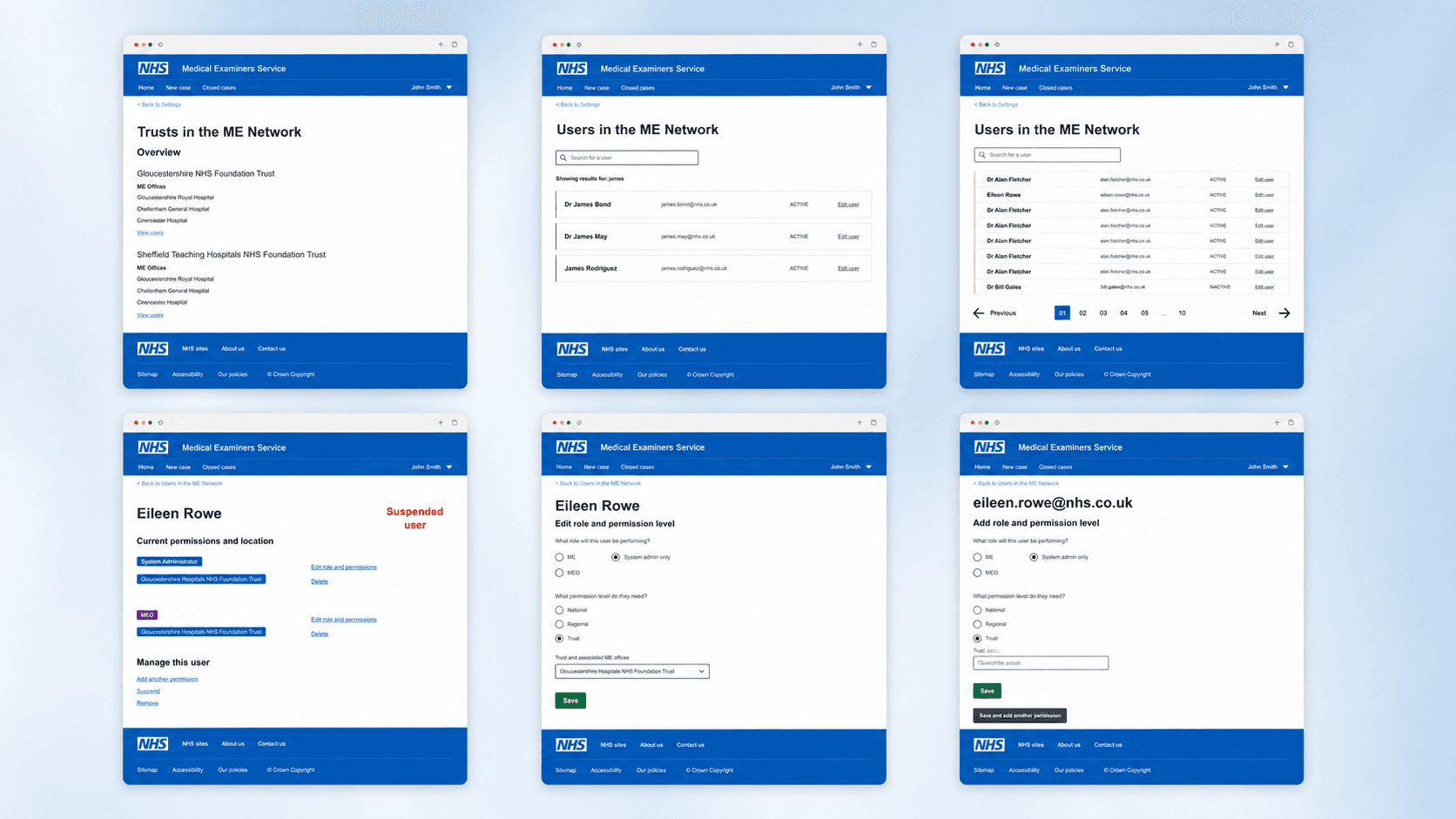
The service needed to support different job roles without losing the shared view of a case. Role assignment controlled who could access and manage different parts of the service, while the medical team view made case ownership and collaboration clearer.
Refining the case breakdown after GDS assessment
My initial concept used an event timeline to create a detailed audit trail across each case, showing conversations, scrutiny and decisions in chronological order. The pattern failed GDS assessment because its complexity created accessibility and usability issues. I redesigned the experience as a structured case breakdown, retaining the visibility and traceability users needed while making individual events easier to scan and understand. The simpler structure also gave developers a clearer implementation path, and the revised pattern later passed GDS assessment.

Turning a complex process into a clear digital service
The Private Beta designs brought the Medical Examiner journey into one consistent service, covering case creation, patient and medical team details, scrutiny, discussions, outcomes and case management. The interface was shaped around the needs of Medical Examiners and Medical Examiner Officers, giving them clearer visibility of case status and a more consistent way to manage complex cases.


From service design to measurable impact
The work moved beyond interface design to establish a service that could be tested, assessed and prepared for wider adoption. Across Alpha and Private Beta, the programme combined repeated prototyping, user testing, scalability exercises and formal assessment, with reported outcomes including improved efficiency, faster processing, compliance and early adoption.